I often feel that All About Lily Chou-Chou isn’t really a movie about youth—it’s a movie about “mediums.” What Shunji Iwai was truly exploring was never school bullying or teenage romance, but rather how human beings use an invisible medium to escape the inescapable pain of physical existence. In the film, that medium is called the “Ether.”
I. Ether: A Theology Predating the Internet
The “Ether” in the film isn’t a physics concept; it’s a belief. Yuichi Hasumi believes the Ether is a substance filling the universe, a medium through which souls communicate. It sounds like science fiction, but to me, it functions more like a substitute for religion—a floating realm built for oneself after reality collapses.
On the BBS board, Hasumi needs no face, no voice, not even a real name. He and “Blue Cat” connect solely through text, recognizing one another within the Ether. That connection feels more “real” than any physical embrace in the real world. Because reality is violent—Shosuke’s bullying, Yoko Kuno’s silence, a mother’s infidelity, a corpse lying in the farm fields. Reality is violent, but the Ether is pure.
When I started this brand, I wasn’t thinking consciously about all of this. But looking back, the philosophy “Not follow. Only wait.” is essentially building my own version of the Ether. The reservation-only system was never meant to be an obstacle; it’s a filter—keeping the “Shosukes” of the real world out, leaving only the “Blue Cats” who are willing to wait. My coffee canisters, aluminum hardware, and the flavor descriptions on my website are simply the physical manifestations of the Ether: containers for intangible experiences, vessels for belief.
II. RELOAD: A Pathological Ritual
I still vividly remember Hasumi sitting in front of his computer, hitting F5 over and over. That action was the norm of waiting back in 2001, but today, it has virtually disappeared. The internet now doesn’t wait—it pushes, algorithms drive it, and it comes at you aggressively. It no longer requires you to refresh; it throws itself at you, laden with information, desire, and noise.
To me, the act of “RELOAD” represents a psycho-pathology left behind by the pre-algorithm era. It implies:
- You believe someone is on the other side of the screen.
- You are willing to spend time for an uncertain response.
- Your anxiety is funneled into a mechanical, repetitive keystroke.
It’s an act of almost sacred futility.
So when I say “Only wait,” what I’m really saying is: We don’t push, we don’t rely on algorithms, and we won’t come running to you. You have to wait for us the way Hasumi waited for Blue Cat. This waiting is painful, uncertain, and inefficient—but that very pain is what proves the connection is real.
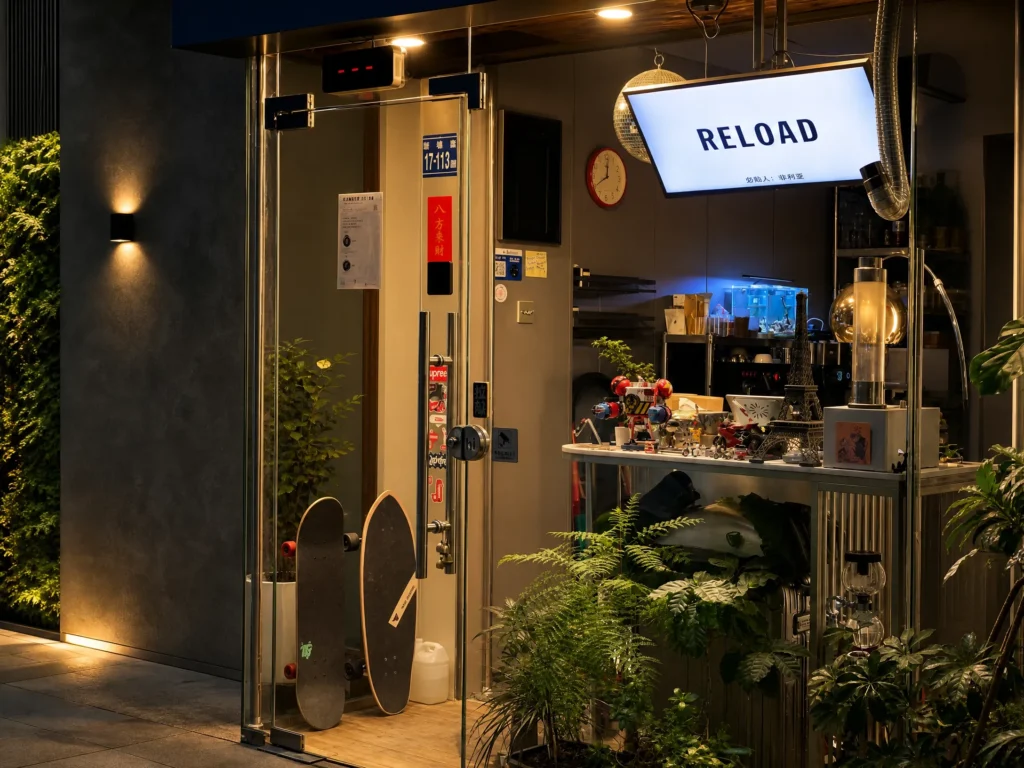
If RELOAD is my collaborative space, it shouldn’t just be a place that serves good coffee. It should be a place for waiting. People go there not to be served, but to experience the ritual of delayed gratification—just like Hasumi in his dark room, facing a glowing screen, waiting for a name to appear.
III. Lily Chou-Chou: The Perpetually Absent Savior
Lily Chou-Chou is a fictional singer. Her music is never played in full throughout the movie; we only see fragmented lyrics, hear muffled snippets, or catch glimpses of the green CD cover. She represents an “absent presence”—an icon that can never truly be reached.
This reflects how I approach coffee. On my website, I wrote, “Every roast exists only for a specific taste.” The cruelty behind this line is that most people will never drink it, nor will they understand it. Lily Chou-Chou’s music wasn’t made for everyone; it was made for those who recognize each other in the Ether. My coffee is no different.
Shunji Iwai’s brilliance lies in the fact that he never tried to bring Lily Chou-Chou “down to earth.” If the movie had ended with Hasumi actually meeting her in person, the entire story would have collapsed instantly. Similarly, if my brand ever tried to “reach more people,” it would collapse too. Scarcity isn’t a marketing strategy; it’s an ontology—my fundamental understanding of what this is.
IV. Violence and Beauty Coexisting on the Same Stem
The most brutal scenes in the film—Yoko Kuno being forced into that room, or Shosuke beating a classmate in the fields—and the most beautiful ones—the kite flying over the rice paddies, the quiet stream of text in the Ether, the green CD cover—are actually two sides of the exact same coin.
Shunji Iwai was telling us: A youth that hasn’t experienced violence can never truly understand beauty; and without a belief in beauty, violence offers no chance of redemption.
My brand handles this exact symbiotic relationship. The monogram pattern on the “Blood-stained LV” canister isn’t just decoration; it’s the scar of violence—the cruelty of the luxury industry, the tyranny of trademark laws, and the corporate appropriation of culture. By using coffee canisters as a medium, I convert that violence into an object of contemplation. I’m not glorifying violence; I’m making it visible. Because only when it is visible can it be understood.
V. Who Blue Cat Is Doesn’t Matter
The biggest twist in the movie is the true identity of “Blue Cat.” But what Iwai really wanted to say was that identity itself doesn’t matter. What matters is that in the Ether, two lonely souls once recognized each other.
My brand operates on the same premise. Reservation systems, per-gram pricing, no over-the-counter sales—all of these mechanics dissolve the traditional identity of a “consumer.” The people who come aren’t “customers.” They are waiters, recognizers—people who find one another in the Ether. We may never know each other’s real names, but we share the same obsession with flavor. And that is enough.
VI. Living inside a 2001 Prophecy
All About Lily Chou-Chou came out in 2001, back when the internet meant dial-up, BBS boards, and forums. Yet, it feels as if Shunji Iwai foresaw today’s digital landscape—a space full of violence, performance, false connections, and genuine isolation.
Today’s social media is essentially the BBS board from the movie, only faster, noisier, and with more hidden violence. Algorithmic feeds have replaced F5 refreshes, but the texture of loneliness remains unchanged.
Thus, “Not follow. Only wait.” is my response to this era. I’m not being nostalgic for dial-up internet; I’m saying that even in an age of constant feed pushes, there are still people willing to wait. This waiting isn’t slowness or apathy—it is an active rejection. A refusal to be fed by algorithms or domesticated by instant gratification. I want to reserve a space for those who are still waiting.
VII. Final Thoughts
At the end of All About Lily Chou-Chou, Hasumi stands in the open field. The kite flies away, but the Ether remains. He hasn’t found an answer, but he hasn’t stopped believing either.
I think that is the true theme of the film: Belief does not require proof, and waiting does not demand a response.
It’s the same with my brand. I’m not just running a business; I’m preserving a belief—in the purity of flavor, the value of waiting, and the discipline of remaining precise in a violent world. Most people won’t get it, but those who do won’t need an explanation.
Shunji Iwai did this through film; I do it through coffee canisters. The mediums are different, but the Ether is the same.
So, RELOAD.It’s the shared soul between my brand and that film: finding a place to breathe between refreshing and waiting, between violence and precision, between loneliness and mutual recognition.
That place is what I set out to create.